Products · DMS · Clergy workforce planning

Deployment arguments,
settled with evidence.

The establishment your DBF actually funds, a ten-year trajectory you can argue with rather than admire, and reorganisation proposals that freeze the figures they were discussed on — so the numbers in the minutes are still the numbers in the system.

10yr
Projection horizon
Post
Modelled role by role
Frozen
Evidence per proposal
FTE
Not headcount
Three layers

Register, trajectory, proposal.

Most deployment conversations fail because those three things live in three documents that disagree. Here each one is built from the one below it.

The establishment register.

Every managed post with how it is paid — stipendiary, part-time, house for duty, self-supporting, externally funded — matched to its benefice, its job category and the person holding it. Vacancies are the funded posts nobody is in, not every empty row in the sheet.

The ten-year trajectory.

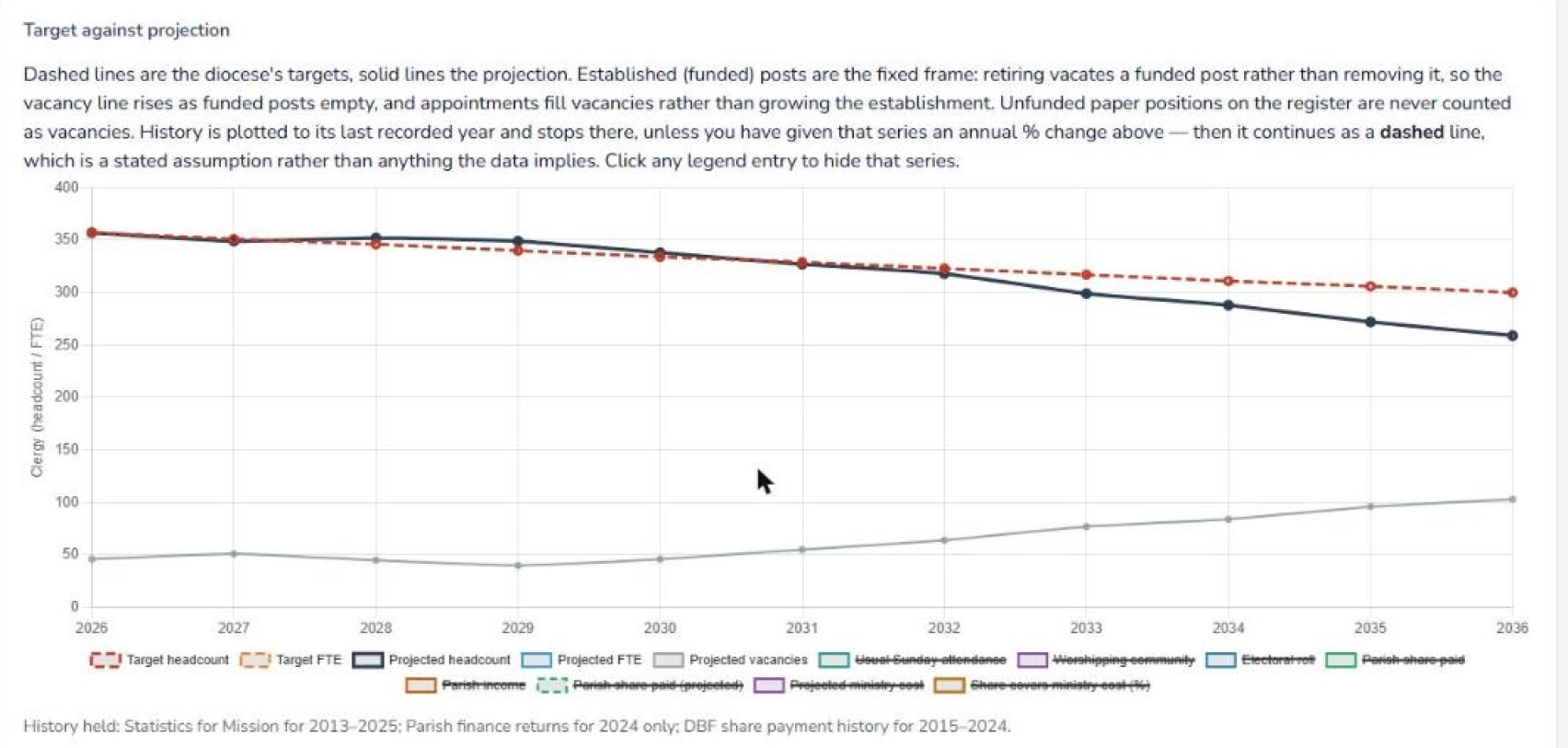
Target establishment against what the register projects, with the historic church-life series behind it. Retirements, ordinations, curacy completion and replacement rates are assumptions you set on the page and watch redraw — not appendices in a paper.

Proposals with frozen evidence.

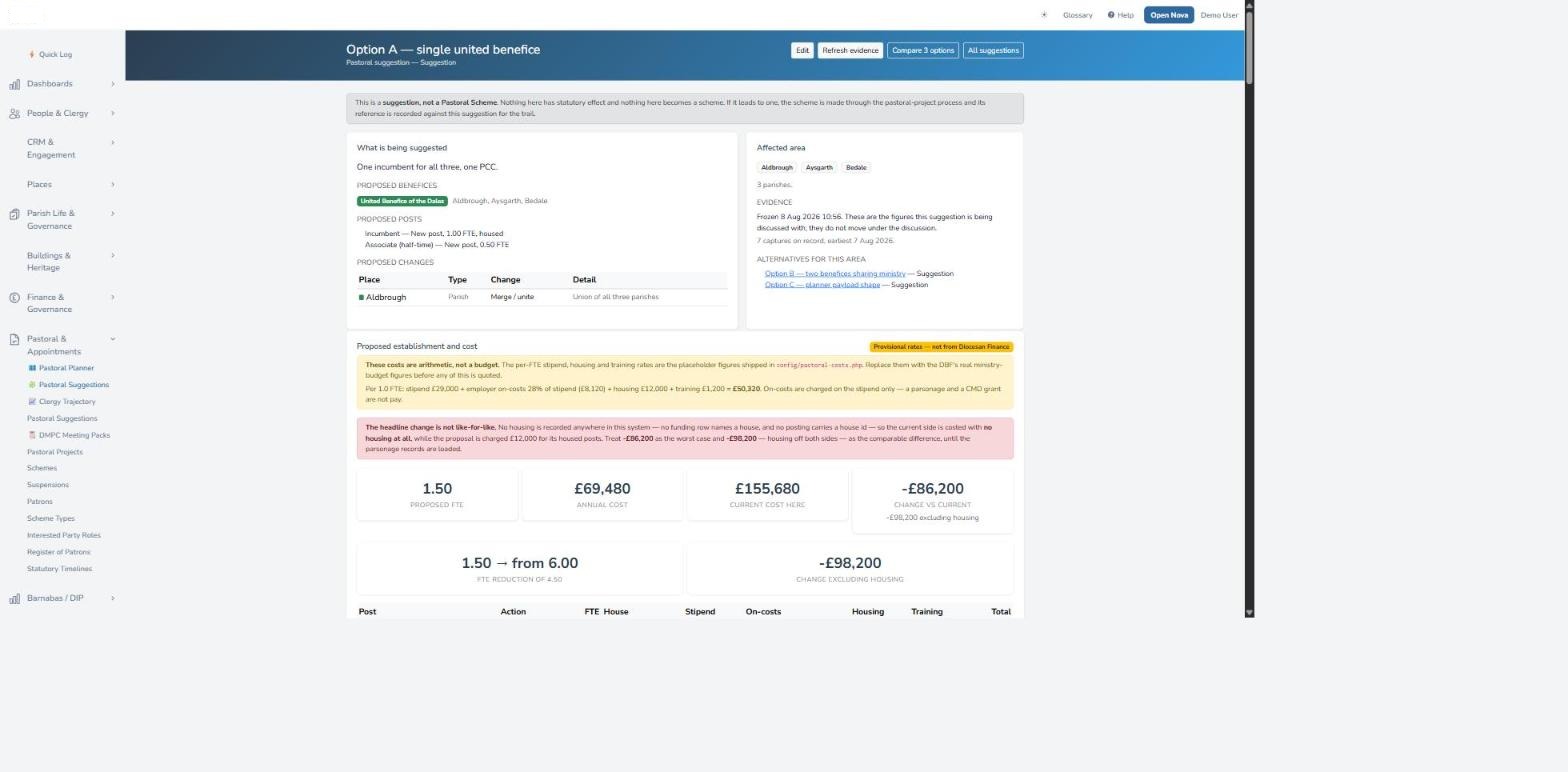
A proposal captures the attendance, income, share, ministry cost and population figures at the moment it was saved. Two proposals over the same parishes are offered side by side automatically. The numbers a meeting discussed stay the numbers on the record.

In the detail

Modelled at the level decisions are made.

Deployment is decided post by post, in a room, with somebody defending a benefice. The tooling has to work at that grain.

Role-level suggestions

Change a post’s FTE, date a departure, drop a funded role or add one that does not exist yet — and the whole projection redraws. Each suggestion belongs to a scenario, so the same person can be modelled differently in two competing plans.

Assumptions you can see

Retirement age, assumed ordination age, curacy completion rate, replacements a year, whether curates fill vacant posts. Every one is on the page with its effect visible, and the page says plainly which figures are assumptions rather than data.

Church-life overlays

Attendance, worshipping community, electoral roll and parish share continued forward at an annual percentage you choose — drawn as a dashed line so nobody mistakes your assumption for a forecast from the data.

Viability, not just totals

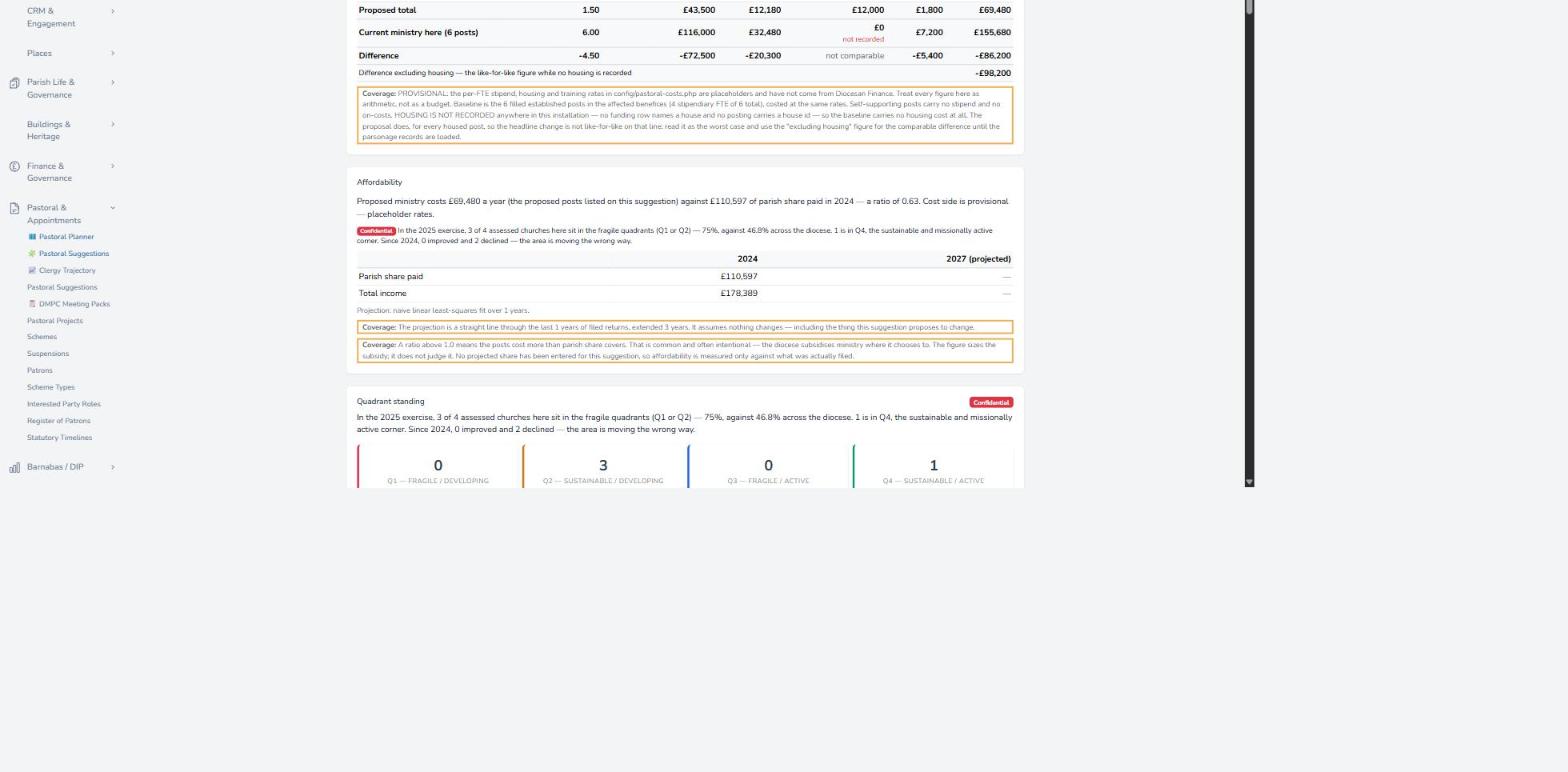
Proposed groupings carry attendance per stipendiary FTE, share required against ministry cost, and cover across the parishes — the ratios a deployment board actually argues over.

Costed in FTE

Ministry cost modelled per full-time equivalent with stipend, on-costs, housing and CMD as separate inputs, so a diocese can put its own DBF figures in and see its own numbers.

Straight into the statutory process

A proposal that gains support hands off into the pastoral project — interested parties, stage checklist and scheme reference — with its own reference recorded against it for the trail. Pastoral planning →

A distinction that matters

A proposal is not a scheme.

Getting this wrong in software is how a thinking-out-loud exercise ends up quoted as a decision.

What it is not
  • Not a Pastoral Scheme. A scheme is a statutory instrument, made elsewhere.
  • Nothing here acquires legal effect by being saved, shared or approved in the room.
  • No parish is notified because somebody sketched an option on a Tuesday.
  • The evidence does not silently update underneath a discussion that already happened.
What it is
  • A way of thinking out loud about a group of parishes, with the figures attached.
  • Evidence frozen and timestamped at the moment of saving.
  • Alternatives over the same parishes offered together, for honest comparison.
  • A clean hand-off into the statutory process if and only if somebody decides to take it there.
What it looks like

On screen.

The trajectory, the deployment table and a proposal with its evidence pack.

Clergy workforce trajectory chart, target against projection
The trajectoryTarget against projection, with the vacancy line rising as funded posts empty. The axis starts at the current year; every assumption behind it is editable on the same screen.
Scenario affordability with quadrant standing
Affordability & viabilityMinistry cost against projected share, with the quadrant standing behind the judgement.
Pastoral proposal with frozen evidence pack
Frozen evidenceThe figures a proposal was discussed on, timestamped and held still.
The hard part of deployment was never the arithmetic. It was that everybody in the room had a different spreadsheet, and none of them agreed on what a vacancy was.
— Why the register, not the sheet, is the source of the vacancy figure
Next step

Model your own
deployment picture.